
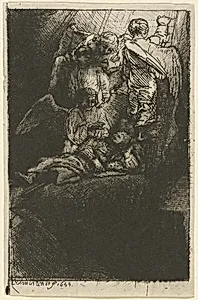
Jacob's Ladder
Medium
etching, burin and drypoint
Dimensions
image: 10.6 × 7 cm (4 3/16 × 2 3/4 in.) sheet (trimmed to plate mark): 11.5 × 7.5 cm (4 1/2 × 2 15/16 in.)
Classification
Department
CG-E
Museum
National Gallery of Art, Washington, D.C.
Credit
Rosenwald Collection
Accession Number
1943.3.7209
Rights
Public Domain
Art Historical Context
Rembrandt van Rijn's *Jacob's Ladder* (1655) captures the biblical dream from Genesis 28 where the patriarch Jacob slumbers beneath a visionary ladder stretching from earth to heaven, flanked by ascending and descending angels Created during the Dutch master's late career amid personal hardships, this intimate etching—measuring just 10.6 × 7 cm—exemplifies Rembrandt's profound engagement with spiritual themes, blending human vulnerability with divine mystery in the Baroque tradition of dramatic light and shadow. Rembrandt's technical brilliance shines through his masterful use of etching, burin, and drypoint on a trimmed sheet. The etching needle creates fluid lines for the ethereal ladder and figures, while drypoint's burr adds velvety texture and depth to the angels' forms and Jacob's recumbent pose. These combined techniques produce a luminous, atmospheric quality rare in prints of the era, allowing subtle tonal gradations that evoke the haze of a dream. Housed in the National Gallery of Art's Rosenwald Collection, this print highlights Rembrandt's innovation in printmaking during the Dutch Golden Age, influencing generations of artists. Its small scale invites close contemplation, rewarding viewers with layers of emotion and spirituality in a single, masterful impression.
About the Artist
Rembrandt van Rijn · 1606–1669
Rembrandt Harmenszoon van Rijn (1606–1669) stands as one of the greatest visual artists in the history of Western art and the most important Dutch painter of the 17th century. Born in Leiden to a prosperous miller's family, Rembrandt transformed painting through his revolutionary use of light and shadow, his psychological depth in portraiture, and his elevation of etching to a fine art. His approx...