
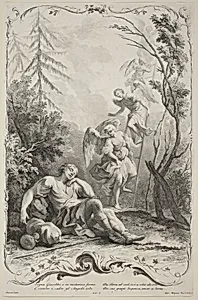
Jacob's Ladder
Medium
etching and engraving on laid paper
Dimensions
sheet (trimmed to plate mark): 52 x 33.8 cm (20 1/2 x 13 5/16 in.)
Classification
Department
CG-E
Museum
National Gallery of Art, Washington, D.C.
Credit
Ailsa Mellon Bruce Fund
Accession Number
1984.84.6
Rights
Public Domain
Art Historical Context
This striking print captures the biblical vision of Jacob’s Ladder, in which the patriarch dreams of angels ascending and descending a celestial stairway. Created around 1745 by Joseph Wagner after a design by the Venetian painter Jacopo Amigoni, the work translates Amigoni’s graceful composition into an etching and engraving on laid paper. Measuring roughly 52 by 34 centimeters, the sheet was carefully trimmed to the plate mark, preserving the crisp lines and delicate tonal gradations that made such reproductive prints highly prized in the eighteenth century. Amigoni, celebrated for his elegant Rococo style, frequently explored religious and mythological subjects that lent themselves to wide circulation through prints. Wagner’s skillful translation allowed viewers across Europe to encounter Amigoni’s vision without traveling to see the original painting. The medium itself—combining the fluid bite of etching with the precise burin work of engraving—enabled both dramatic contrasts and fine detail, making the heavenly scene vivid and accessible. Today, this impression in the National Gallery of Art’s collection, acquired through the Ailsa Mellon Bruce Fund, offers visitors a window into how eighteenth-century printmaking bridged elite art and a broader public, preserving and popularizing important compositions for generations.