
Jacques Amelot
ca. 1655
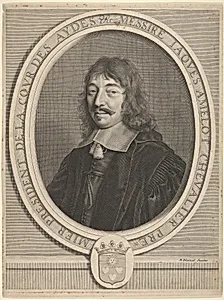
Medium
Engraving; first state of three (Petitjean & Wickert)
Dimensions
Sheet: 12 15/16 × 9 3/4 in. (32.9 × 24.8 cm)
Classification
Prints
Department
Drawings and Prints
Museum
Metropolitan Museum of Art, New York, NY
Credit
Gift of Dr. Ralph Weiler, 1960
Accession Number
60.563.45
Rights
Public Domain
Tags
Art Historical Context
This engraving by Robert Nanteuil, created around 1655, captures the likeness of Jacques Amelot in a refined portrait that reflects the formal conventions of 17th-century French printmaking. As the state of three, it offers a rare glimpse into the artist’s working process, revealing the initial lines and details before later refinements were added. Nanteuil, a leading figure in the field, specialized in such portraits, using engraving techniques to achieve precise textures and subtle tonal gradations on the copper plate. Prints like this one played a vital cultural role by making individual portraits more widely available beyond painted originals. The medium allowed for multiple impressions, helping to document and circulate images of notable figures across Europe. Measuring just over 12 by 9 inches, the sheet balances intimate scale with impressive detail, inviting close viewing of the subject’s features and attire. Now part of the Metropolitan Museum of Art’s collection through a 1960 gift, the work stands as a fine example of how engravings served both artistic and social purposes in their time.
About the Artist
Robert Nanteuil · 1623–1678
Robert Nanteuil (1623-1678) was a French portrait engraver, draughtsman, and pastellist who became the preeminent portraitist to the court of Louis XIV. His technical mastery and royal patronage fundamentally transformed the status of engraving in France, elevating it from a mechanical craft to a recognized fine art. Nanteuil stands as the outstanding French portrait engraver of the seventeenth c...