
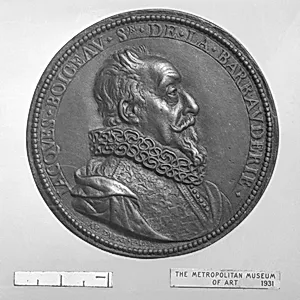
Jacques Boiceau, Seigneur de la Barauderie
Unknown Artist
17th century
Medium
Bronze
Dimensions
Diameter (confirmed): 68.5 mm
Classification
Medals and Plaquettes
Culture
French
Department
European Sculpture and Decorative Arts
Museum
Metropolitan Museum of Art, New York, NY
Credit
Bequest of Gwynne M. Andrews, 1931
Accession Number
31.33.144
Rights
Public Domain
Tags
Art Historical Context
This exquisite 17th-century bronze medal measuring 68.5 mm in diameter, portrays Jacques Boiceau, de la Barauderie in profile—a classic convention in European portrait medals that evoked ancient coins. Produced in France during the Baroque era, it belongs to the esteemed tradition of medals and plaquettes small-scale sculptures that commemorated nobles, scholars, and collectors The inclusion of butterflies in the likely serves as a personal emblem or rebus, possibly alluding to Boice's name or interests, adding a layer of symbolic intrigue to this intimate artwork. Artistically, the medal exemplifies the technical mastery of bronze casting prevalent in 17th-century France, where artisans drew inspiration from Renaissance revivals of classical antiquity. Boiceau himself was a renowned antiquarian and collector of ancient coins and medals, making this piece a fitting tribute to his passions. Such objects were prized in elite circles for their dual role as portraiture and conversation pieces, blending portrait realism with emblematic motifs. Now housed in the Metropolitan Museum of Art's Department of European Sculpture and Decorative Arts through the 1931 bequest of Gwynne M. Andrews, this medal offers visitors a window into the intellectual and aristocratic world of ancien régime France, where art and scholarship intertwined.