
Jade Bezel
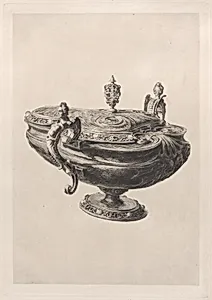
Medium
Etching
Dimensions
Sheet: 19 13/16 × 14 3/16 in. (50.3 × 36 cm) Plate: 16 9/16 × 11 11/16 in. (42 × 29.8 cm)
Classification
Prints
Department
Drawings and Prints
Museum
Metropolitan Museum of Art, New York, NY
Credit
Gift of Howard Mansfield, 1917
Accession Number
17.6.16
Rights
Public Domain
Art Historical Context
Welcome to the Metropolitan Museum of Art's Drawings and Prints collection, where Jules-Ferdinand Jacquem's *Jade Bezel* (1868) captivates with its exquisite detail. This etching, generously gifted by Howard Mansfield in 1917 measures a generous sheet of 19 13/16 × 14 3/16 inches, showcasing the French artist's mastery in reproducing luxurious objects. Jacquemart, a leading 19th-century etcher, specialized in meticulous renderings of decorative arts, often drawing from museum treasures to celebrate global craftsmanship. Created during France's Second Empire era—a time of fascination with Orientalism and exotic imports—*Jade Bezel* highlights the allure of jade, a prized material in East Asian art symbolizing purity and immortality. Jacquemart's etching technique, involving acid-etched metal plates for intricate lines, allowed him to capture the stone's translucent glow and subtle textures with photographic precision, bridging printmaking and scholarly documentation. This work exemplifies the 19th-century trend of artist-engravers preserving fragile artifacts through prints, making elite collections accessible. Marvel at how Jacquemart transforms a simple bezel—a jade frame or mount—into a window on cross-cultural exchange, inviting you to appreciate the fusion of Eastern elegance and Western virtuosity.
About the Artist
Jules-Ferdinand Jacquemart · 1837–1880
**Jules-Ferdinand Jacquemart: Master Etcher and Watercolorist** Jules-Ferdinand Jacquemart was born on September 7, 1837, in Paris to Albert Jacquemart, a prominent art collector, ceramics historian, and amateur artist, and Louise Émilie Labbé. The third of four children, he received his initial training in etching from his father, who had no formal master himself and emphasized self-taught preci...