
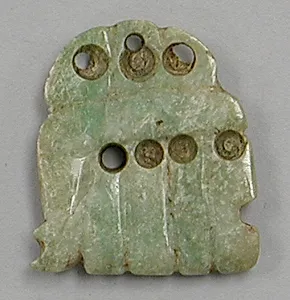
Jade Inlay
Unknown Artist
before 16th century
Medium
Jade
Dimensions
Height 1-1/2 in.
Classification
Stone-Ornaments
Culture
Mexican
Department
Arts of Africa, Oceania, and the Americas
Museum
Metropolitan Museum of Art, New York, NY
Credit
Bequest of Arthur M. Bullowa, 1993
Accession Number
1994.35.523
Rights
Public Domain
Art Historical Context
This delicate **Jade Inlay**, crafted by an unknown Mexican artist before the 16 century, exemplifies the masterful stonework of pre-Columbian Meso. Standing just 1-1/2 inches tall, this small jade ornament from the Metropolitan Museum of Art's Department of Arts of Africa,, and the Americas, likely designed to be set into larger objects like masks, jewelry, or ceremonial items. Jade, prized for its vibrant green hue symbolizing vitality and preciousness in ancient Mexican cultures, was laboriously carved from hard stone using simple tools, showcasing the artisans' extraordinary skill and patience. In pre-Hispanic Mexico, such inlays held profound cultural importance, often adorning elite burials or ritual artifacts to evoke divine qualities like fertility and water—essential life forces. The piece's modest size belies its significance: these intricate fittings contributed to stunning mosaic effects, blending artistry with spiritual symbolism. Bequeathed to the Met in 1993 by Arthur M. Bullowa, it offers a tangible link to a sophisticated civilization predating European contact. Visitors, marvel at how this tiny treasure captures the ingenuity of ancient Mexican jade workers, whose techniques influenced centuries of ornamental traditions.