
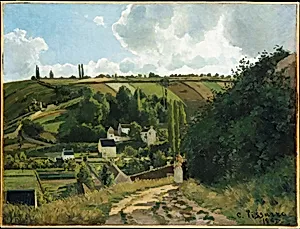
Jalais Hill, Pontoise
Camille Pissarro, 1867
About this artwork
Camille Pissarro'sJalais Hill, Pontoise* (1867), an oil on canvas measuring ¼ × 45¼ inches, vividly captures the rolling rural landscapes and farms of Pontoise a town northwest of Paris that became a cradle for Impressionism. Painted before Pissarro fully embraced the, this expansive work showcases his pioneering plein-air approach—painting outdoors to truthfully depict everyday French countryside life, with its subtle atmospheric effects and shifting light across the hillside. Exhibited at the Salon of1868, the painting earned high praise from critic Émile Zola, who hailed it as embodying "the modern countryside," boosting Pissarro's reputation as an innovative landscapist. Rather than idealizing nature, Pissarro emphasized the region's working agricultural character, foreshadowing his lifelong focus on peasant labor. The ambitious large-scale canvas elevated humble landscapes to the grandeur of history painting. Pontoise remained a key site in Pissarro's career, drawing artists like Cézanne in the 1870s. Bequeathed to the Metropolitan Museum of Art in 1951 by William Church Osborn, it graces Gallery 820, offering a window into the pivotal pre-Impressionist moment in French art.