
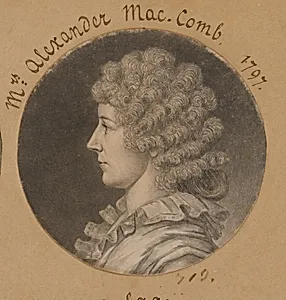
Janet Marshall Macomb
Medium
Classification
Department
Smithsonian Collection
Museum
Smithsonian American Art Museum
Credit
National Portrait Gallery, Smithsonian Institution; gift of Mr. and Mrs. Paul Mellon
Accession Number
S/NPG.74.39.16.6
Rights
Public Domain
Tags
Art Historical Context
In the National Portrait Gallery's at the Smithsonian American Art Museum,Janet Marshall Macomb*1797) is a delicate print portrait by Charles Balthazar Julien Féret de Saint-Mé, a French émigré artist who arrived in America amid the Revolution's upheavals. Capturing the poised profile of female subject, this work exemplifies Saint-Mémin signature physionotrace technique—a process blending mechanical tracing with hand-engraving to produce precise, cameo-like silhouettes on ivory-toned paper. Gifted by Mr. and Mrs. Paul Mellon, it reflects the artist's role in documenting early American elite during the Federal period. Created just a decade after the U.S. Constitution's ratification, the portrait embodies the neoclassical elegance favored in post-Revolutionary society, where profile views evoked ancient Roman coins and celebrated republican virtue. Saint-Mémin's methodical approach allowed for affordable, reproducible likenesses, making portraiture accessible beyond oil paintings reserved for the wealthiest. Janet Marshall Macomb, likely from a prominent New York family tied to military and mercantile circles, represents the refined women shaping the young nation's social fabric. This print not only preserves a personal story but also highlights the fusion of European artistry with American identity, inviting visitors to ponder how such intimate images helped forge a visual record of the early republic.