
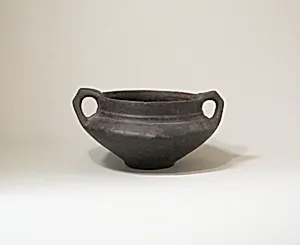
Jar
Unknown Artist
ca. 700–675 BCE
Medium
Terracotta
Dimensions
Overall: 3 1/16in. (7.8cm) Other: 4 9/16in. (11.6cm)
Classification
Vases
Culture & Period
Etruscan · Villanovian/Orientalizing
Department
Greek and Roman Art
Museum
Metropolitan Museum of Art, New York, NY
Credit
Purchase by subscription, 1896
Accession Number
96.18.81
Rights
Public Domain
Art Historical Context
This delicate terracotta jar, dating to around 700–675 BCE, hails from the vibrant Etruscan of ancient Italy during the transitional Villanovian/Oriental period. Standing just over 3 inches tall with a wider base measurement of about 4½ inches, it exemplifies the early craftsmanship of a society poised between Iron Age simplicity and the influx of Eastern Mediterranean influences. Etruscans, precursors to Roman dominance, were renowned for their pottery, which served both practical and ritual purposes, such as storing oils, grains, or cremated remains in funerary contexts. Crafted from fired clay, this jar reflects the era's terracotta techniques: wheel-thrown or hand-built forms, burnished surfaces, and subtle geometric patterns hinting at the shift from Villanovan austerity—marked by biconical urns—to the more ornate Orientalizing style inspired by Greek, Phoenician, and Near Eastern motifs. Though plain in decoration, its compact form underscores the Etruscans' mastery of proportion and durability, vital for daily and ceremonial life. Acquired by the Metropolitan Museum of Art in 1896 through public subscription, this vessel offers a tangible link to Etruria's enigmatic world, inviting us to ponder the lives of its anonymous makers and users in pre-Roman Italy.