
Jar
Unknown Artist
9th–10th century
Medium
Stone; carved and incised
Dimensions
H. 11 in. (27.9 cm) Diam. 12 1/2 in. (31.8 cm)
Classification
Stone
Department
Islamic Art
Museum
Metropolitan Museum of Art, New York, NY
Credit
Rogers Fund, 1936
Accession Number
36.20.6
Rights
Public Domain
Tags
Art Historical Context
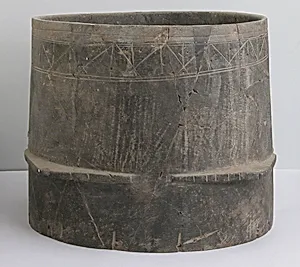
This elegant stone jar, crafted by an unknown artist during the 9th–10th century, exemplifies the refined stoneworking traditions of the Islamic world. 11 inches tall with a generous 12½-inch diameter, it was likely used for storage or ceremonial purposes, its sturdy form highlighting the practicality and beauty of everyday objects in medieval Islamic society. Housed in the Metropolitan Museum of Art's Art department (Rogers Fund, 1936), it invites visitors to ponder the anonymous artisans whose skills bridged utility and artistry. The jar's creation through carving and incising—techniques involving meticulous cutting and grooving into the stone surface—demonstrates advanced craftsmanship from the Abbasid era, a golden age of Islamic innovation. These methods allowed for intricate surface decoration, often featuring geometric motifs or floral patterns that adhered to Islamic aniconic principles, emphasizing abstraction and infinite repetition to evoke spiritual harmony. As a survivor from over a millennium ago, this jar offers a tangible link to the vibrant trade networks and cultural exchanges across the early medieval Islamic realms, from Mesopotamia to Central Asia. Its preservation underscores stone's enduring quality, making it a quiet testament to the ingenuity of forgotten makers.