
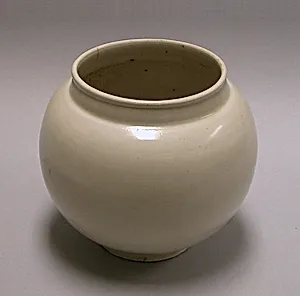
Jar
Unknown Artist
11th–12th century
Medium
Porcelain with creamy white glaze (Ding ware)
Dimensions
H. 5 in. (12.7 cm); Diam. 5 5/8 in. (14.3 cm)
Classification
Ceramics
Culture & Period
China · Northern Song dynasty (960–1127)
Department
Asian Art
Museum
Metropolitan Museum of Art, New York, NY
Credit
Rogers Fund, 1916
Accession Number
16.20.1
Rights
Public Domain
Art Historical Context
This delicate jar, crafted by an unknown artist during China's Northern Song dynasty (9601127), exemplifies the's refined ceramic artistry. Measuring just 5 inches high and 5⅝ inches in diameter, is made of porcelain with signature creamy white glaze characteristic Ding ware. Produced inns in present-day He province, Ding ware was prized for its fine, ivory-toned surface, achieved through high-temperature firing that yielded a smooth, often subtly crackled finish. The Northern Song period marked a golden age for Chinese ceramics, with potters technical boundaries to create translucent bodies and elegant glazes that prioritized purity over decoration. This unadorned jar reflects Song aesthetics—emphasizing harmony, simplicity, and natural beauty—likely serving as a modest storage vessel for spices, cosmetics, or medicines in elite households. Its modest scale belies its cultural significance, as Ding ware influenced imperial tastes and later porcelain traditions worldwide. Now part of the Metropolitan Museum of Art's Asian Art collection (acquired via the Rogers Fund in 1916), this jar offers visitors a tangible glimpse into Song innovation, where everyday objects embodied philosophical ideals of restraint and perfection.