
Jar
Unknown Artist
early 20th century
Medium
Stoneware with inlaid decoration under buncheong glaze
Dimensions
H. 7 1/2 in. (19.1 cm); Diam. 6 1/2 in. (16.5 cm)
Classification
Ceramics
Culture
Korea
Department
Asian Art
Museum
Metropolitan Museum of Art, New York, NY
Credit
Gift of Samuel T. Peters, 1915
Accession Number
15.29.16
Rights
Public Domain
Art Historical Context
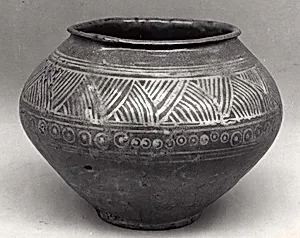
This elegant stoneware jar, crafted by an unknown Korean artist in the early 20th century, the enduring tradition of buncheong ware—a cherished form of Korean ceramics. Standing at just 7½ inches tall and 6½ inches in diameter, its compact, rounded form was likely used for storing spices, oils, or grains in everyday households. The medium features a grey stoneware body adorned with inlaid decoration, where contrasting clay slips (often white) are pressed into incised designs before being coated with a thin buncheong glaze. This glaze, a soft celadon-like finish, fires to a subtle, matte sheen that highlights the tactile textures beneath. Buncheong pottery originated in the 14th to 16th centuries during Korea's Goryeo and early Joseon dynasties, bridging the refined celadons of Goryeo with the folk artistry of Joseon. By the early 20th century—amid Japan's colonial rule—artisans revived these techniques, blending functionality with subtle aesthetic appeal. The inlay method, known as sanggam, creates intricate patterns that emerge delicately through the glaze, symbolizing Korea's innovative approach to ceramics that prized imperfection and natural beauty over imperial perfection. Acquired by the Metropolitan Museum of Art in 1915 as a gift from Samuel T. Peters, this jar offers a window into Korea's resilient ceramic heritage, inviting visitors to appreciate the quiet mastery of its anonymous maker.