
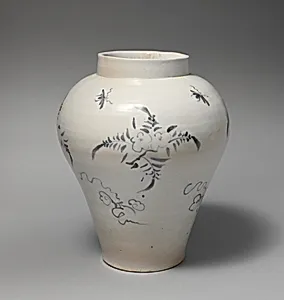
백자 청화 꽃 곤충 무늬 항아리 조선|白磁靑畫花蟲文壺 朝鮮|Jar decorated with flowers and insects
Unknown Artist
mid-18th century
Medium
Porcelain with underglaze cobalt-blue design
Dimensions
H. 13 1/2 in. (34.3 cm); Diam. 11 3/8 in. (28.9 cm); Diam. of base: 5 1/2 in. (14 cm); Diam. of rim: 5 5/8 in. (14.3 cm)
Classification
Ceramics
Culture & Period
Korea · Joseon dynasty (1392–1910)
Department
Asian Art
Museum
Metropolitan Museum of Art, New York, NY
Credit
Purchase, Parnassus Foundation/Jane and Raphael Bernstein Gift, and Diane Carol Brandt Gift, 2005
Accession Number
2005.406
Rights
Public Domain
Tags
Art Historical Context
This elegant jar, crafted in Korea during the mid-18th century Joseon dynasty (1392–1910), exemplifies the refined artistry of white porcelain known as *baekja*. Adorned with undergl cobalt-blue designs of delicate flowers and insects, it showcases the period's mastery of subtle, nature-inspired motifs. The porcelain body gleams with a smooth, milky-white glaze, while the vivid blue pigment—imported cobalt applied before firing—creates enduring, vibrant patterns that seem to dance across the surface. Joseon ceramics were prized for their purity and technical precision, often produced in royal kilns or workshops for both daily use and elite collections. The underglaze technique, influenced by Ming dynasty China but uniquely Korean in its restraint, ensured designs wouldn't fade over time, highlighting the era's emphasis on harmony between humanity and nature. Flowers and insects here evoke seasonal cycles and the fleeting beauty of life, common themes in East Asian art that reflected Confucian ideals of balance. Measuring about 13½ inches tall, this jar would have served as a practical vessel—perhaps for storing grains or liquids—while doubling as a decorative treasure. Its anonymous creation underscores the collaborative genius of Joseon potters, whose anonymous works continue to captivate with timeless elegance.