
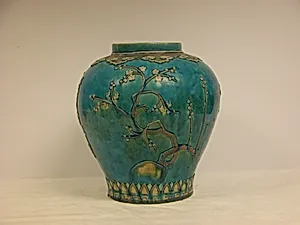
明 法華梅紋罐|Jar decorated with plum blossoms
Unknown Artist
early 16th century
Medium
Stoneware with aubergine and turquoise glaze (Fahua ware)
Dimensions
H. 14 7/8 in. (37.8 cm)
Classification
Ceramics
Culture & Period
China · Ming dynasty (1368–1644)
Department
Asian Art
Museum
Metropolitan Museum of Art, New York, NY
Credit
Bequest of John D. Rockefeller Jr., 1960
Accession Number
61.200.68
Rights
Public Domain
Art Historical Context
This elegant jar, titled *Jar Decorated with Plum Bloss* (明 法華梅紋罐), hails from early 16th-century China during the Ming dynasty (1368–1644). Standing at 14⅞ inches (37.8 cm) tall, it exemplifies Fahua ware—a distinctive stoneware known for its vibrant overglaze enamels Here, plum blossoms are rendered in striking aubergine (a rich purple) and turquoise glazes, applied over a dark body and fired at low temperatures to create bold, jewel-like colors that pop against the surface. Fahua ceramics emerged in the 15th century, primarily from kiln centers like those in Shanxi and Henan provinces, blending stoneware durability with porcelain-like decoration. The technique involved incising designs into the clay, applying colored slips, and layering translucent enamels, resulting in a sculptural quality prized by Ming elites for vases, temple wares, and scholarly objects. Though less common than imperial blue-and-white porcelain, Fahua's exuberant palette reflected the dynasty's artistic innovation and trade influences. Plum blossoms hold deep cultural resonance in China, symbolizing resilience and hope as they bloom amid winter snow. This jar, with its graceful form and lively motifs, likely served both decorative and ceremonial purposes. A generous bequest from John D. Rockefeller Jr. in 1960 now graces the Metropolitan Museum of Art's Asian Art collection, inviting us to appreciate Ming craftsmanship's timeless allure.