
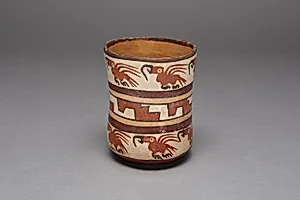
Jar Depicting Rows of Macaws and Abstract Stepped Motif
180 BCE–500 CE
Medium
Ceramic and pigment
Dimensions
12.4 × 9.8 cm (4 7/8 × 3 7/8 in.)
Classification
earthenware
Department
Arts of the Americas
Museum
Art Institute of Chicago
Accession Number
91151
Rights
Public Domain
Art Historical Context
This exquisite Nasca jar, crafted between 180 BCE and 500 CE, showcases the vibrant artistry of the ancient Nasca culture from Peru's southern coast. Standing just 12.4 × 9.8 cm, this small earthenware vessel is adorned with rows of colorful macaws—tropical parrots rendered in vivid reds, yellows, and blacks using slip-painted pigments on a polished ceramic surface. An abstract stepped motif frames the birds, evoking the geometric patterns seen in Nasca textiles and architecture, possibly symbolizing terraced landscapes or ritual stairways linked to water and fertility in their arid environment. Nasca potters were master ceramicists, firing vessels at low temperatures to achieve the fine, double-chambered forms ideal for liquids or offerings. This technique allowed for the intricate polychrome designs that defined their style, blending naturalistic animals with symbolic abstraction—a hallmark of Andean Pre-Columbian art. Macaws, native to Amazonian regions, highlight Nasca's extensive trade networks, bringing exotic motifs into their repertoire. Housed in the Art Institute of Chicago's Arts of the Americas collection, this jar offers a window into Nasca society, where such pottery played roles in rituals, burials, and daily life, celebrating the harmony between humans, nature, and the cosmos.
About the Artist
Nasca
Nasca artists, active from approximately 100 BCE to 800 CE along the arid southern coast of Peru in the Rio Grande de Nazca and Ica Valleys, produced some of the most vibrant and technically innovative art of the ancient Americas. Their work emerged from the Paracas tradition, expanding on earlier resin-painted ceramics and complex textiles while introducing pre-fire slip painting in up to twelve ...