
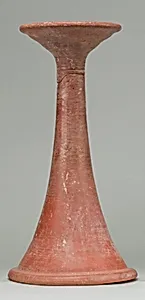
Jar stand
Unknown Artist
ca. 1640–1470 B.C.
Medium
pottery
Dimensions
H. 37 cm (14 9/16 in)
Classification
Jar stand
Period
Second Intermediate Period–Early New Kingdom
Department
Egyptian Art
Museum
Metropolitan Museum of Art, New York, NY
Credit
Rogers Fund, 1932
Accession Number
32.3.225
Rights
Public Domain
Art Historical Context
This elegant jar stand, crafted around 1640–1470 B.C. during Egypt's Second Intermediate Period to Early New Kingdom (late Dynasty17–early Dynasty 18), offers a glimpse into a pivotal era of transition. This time bridged the fragmented rule of foreign Hyksos invaders and the resurgence of native Egyptian power from Thebes, paving the way for the New Kingdom's golden age of pharaohs like Thutmose III. Standing 37 cm tall, the stand was designed to elevate jars, likely for practical storage of grain, oils, or wine in households or temples, reflecting everyday ingenuity amid political upheaval. Fashioned from pottery—a staple medium in ancient Egypt due to the Nile's abundant clay—this piece highlights the era's ceramic expertise. Potters used local silt, firing it to create sturdy, functional forms that could withstand daily use or ritual demands. Though the artist remains unknown, such objects embody the continuity of Egyptian craftsmanship, blending utility with subtle aesthetic appeal. Acquired through the Rogers Fund in 1932 and housed in the Metropolitan Museum of Art's Egyptian Art department, this jar stand invites us to ponder the lives of those who shaped Egypt's path to empire, one vessel at a time.