
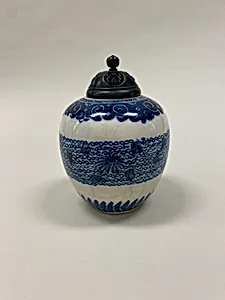
Jar with floral scrolls
Unknown Artist
late 17th–early 18th century
Medium
Soft paste porcelain painted in underglaze cobalt blue (Jingdezhen ware)
Dimensions
H. 5 7/8 in. (14.9 cm); Diam. 4 1/2 in. (11.4 cm)
Classification
Ceramics
Culture & Period
China · Qing dynasty (1644–1911), Kangxi period (1662–1722)
Department
Asian Art
Museum
Metropolitan Museum of Art, New York, NY
Credit
Bequest of Benjamin Altman, 1913
Accession Number
14.40.269a, b
Rights
Public Domain
Art Historical Context
This delicate jar, adorned with swirling floral scrolls, exemplifies the porcelain artistry of China's Jingdezhen kilns during the Kangxi (1662–1722) of the Qing dynasty Produced in the late 17th to early 18th century it stands just under 6 inches tall, making it a perfect example of the small-scale vessels prized for both utility and display in elite households. The anonymous artisan's design features rhythmic, blooming motifs painted in vibrant underglaze cobalt blue technique perfected at Jingdezhen, where high-fired porcelain achieved its legendary durability and translucency. Jingdezhen ware, often called the "porcelain capital of the world," reached new heights under Emperor Kangxi, with cobalt blue underglaze allowing intricate patterns to emerge bold and unfading beneath the glassy glaze. Floral scrolls like those here symbolized prosperity and harmony, reflecting Confucian ideals and the era's fascination with nature's elegance. Soft-paste porcelain, though less common than hard-paste in this period, highlights experimental refinements in clay bodies for finer textures. Bequeathed to the Metropolitan Museum of Art in 1913 by Benjamin Altman, this jar invites visitors to appreciate the Qing dynasty's masterful blend of technical innovation and aesthetic grace, bridging imperial courts and global trade routes.