
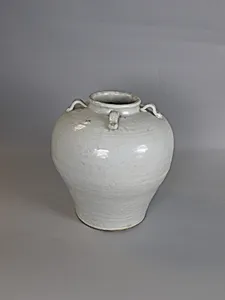
Jar with four lugs
Unknown Artist
16th century
Medium
Porcelain with incised decoration under white glaze (Jingdezhen ware)
Dimensions
H. 10 1/2 in. (26.7 cm); W. 9 1/2 in. (24.1 cm)
Classification
Ceramics
Culture & Period
China · Ming dynasty (1368–1644)
Department
Asian Art
Museum
Metropolitan Museum of Art, New York, NY
Credit
Rogers Fund, 1917
Accession Number
17.169
Rights
Public Domain
Art Historical Context
This elegant *Jar with Four Lugs* hails from China's Ming dynasty (13681644), specifically the 16th century and exemplifies the pinnacle of imperial porcelain production at Jingdezhen, the renowned center for fine ceramics. Standing 10 inches tall and 9½ inches wide, its rounded body flares to a short neck adorned with four sturdy lugs—practical handles or decorative knobs—making it both functional and visually striking. The pristine white glaze over incised decoration creates a subtle, tactile elegance, where motifs are delicately carved into the soft clay before firing, allowing the glaze to settle into the grooves for a soft, shadowed relief effect. Crafted during the Ming era's golden age of porcelain, this piece showcases technical virtuosity: Jingdezhen kilns perfected the use of kaolin clay for durable, translucent bodies that could withstand high temperatures, producing wares prized by emperors and elites for storage, altars, or export. The incising technique, a labor-intensive method predating painted enamels, highlights the artisan's precision and restraint, evoking the dynasty's aesthetic of refined simplicity. Acquired through the Rogers Fund in 1917, it now graces the Metropolitan Museum of Art's Asian Art collection, offering a window into Ming China's cultural splendor and enduring ceramic legacy.