
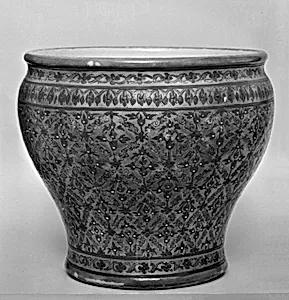
Jar with geometric pattern
Unknown Artist
19th century
Medium
Porcelain painted in overglaze polychrome enamels (Bencharong ware)
Dimensions
H. 7 3/8 in. (18.7 cm); Diam. 8 1/4 in. (21 cm)
Classification
Ceramics
Culture & Period
China · Qing dynasty (1644–1911)
Department
Asian Art
Museum
Metropolitan Museum of Art, New York, NY
Credit
Avery Fund, 1909
Accession Number
09.70.70
Rights
Public Domain
Art Historical Context
This elegant jar, adorned with intricate geometric patterns, exemplifies the exquisite porcelain artistry of China's Qing dynasty (1644–1911), crafted in the 19th by an unknown artist. Standing at 7 3/8 inches tall 8 1/4 inches in diameter it belongs to the rare Bencharong ware tradition—porcelain produced in Jingdezhen kilns specifically for export to Thailand. The term "Bencharong," "five colors" in Thai, highlights its hallmark use of vibrant overglaze polychrome enamels in reds, blues, greens, yellows, and whites, applied after the initial high-fired glaze for luminous, jewel-like effects. The overglaze enameling technique involved painting delicate motifs on the fired porcelain surface, followed by a low-temperature firing to fuse the colors without dulling their intensity. Geometric designs like those on this jar symbolized harmony and cosmic order in East Asian aesthetics, while also appealing to Thai elite tastes for opulent, temple-inspired decoration. Often used to hold incense or offerings in noble households, such jars bridged Chinese technical mastery with Southeast Asian cultural flair. Acquired through the Avery Fund in 1909 and now housed in the Metropolitan Museum of Art's Asian Art Department, this piece invites visitors to appreciate the global exchanges of the Qing era, where porcelain became a canvas for cross-cultural splendor.