
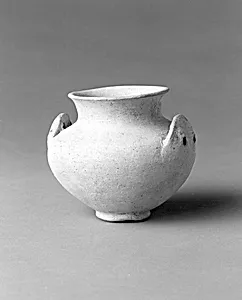
Jar with pierced handles for suspension
Unknown Artist
ca. 3300–3100 BCE
Medium
Ceramic
Dimensions
4.02 x 4.49 in. (10.21 x 11.4 cm)
Classification
Ceramics-Vessels
Period
Late Uruk
Department
Ancient Near Eastern Art
Museum
Metropolitan Museum of Art, New York, NY
Credit
Gift of the Robert Haber family, 1993
Accession Number
1993.468.5
Rights
Public Domain
Art Historical Context
This delicate ceramic jar, dating to the Late Uruk period around 3300–3100 BCE, hails from ancient Mesopotamia in the Ancient Near East—modern-day Iraq. The Uruk culture represents one of humanity's earliest urban civilizations, with burgeoning cities, complex societies, and innovations in craft that laid the groundwork for Sumerian achievements. Standing just over 4 inches tall, this vessel exemplifies the practical artistry of the time, when pottery was essential for daily life, storage, and ritual purposes. Crafted from ceramic, the jar features pierced handles designed for suspension, likely via cords or thongs, allowing it to be hung safely off the ground to protect contents like grains, oils, or liquids from pests and moisture. This functional innovation highlights the ingenuity of Late Uruk potters, who hand-built or early-wheel-thrown forms with increasing refinement, marking a shift toward standardized production in growing urban centers. On view in the Metropolitan Museum of Art's Ancient Near Eastern Art department, thanks to a 1993 gift from the Robert Haber family, this unadorned yet elegant piece offers a tangible glimpse into prehistoric daily life, bridging the gap between Neolithic simplicity and the grandeur of later Mesopotamian empires.