
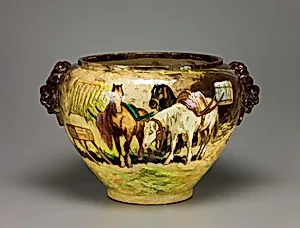
Jardinière
ca. 1877–79
Medium
Earthenware
Dimensions
16 x 25 1/4 in. (40.6 x 64.1 cm)
Classification
Jardinière
Culture
American
Department
The American Wing
Museum
Metropolitan Museum of Art, New York, NY
Credit
Gift of Robert A. Ellison Jr., 2018
Accession Number
2018.294.265
Rights
Public Domain
Tags
Art Historical Context
Nestled in The American Wing of the Metropolitan Museum Art, this striking *Jardinière* (ca. 1877–79) is a fine example of late 19th-century American earthenware craftsmanship. Produced by Edouard Pottery in collaboration with Charles Volkmar French-born potter who brought European techniques to American studios—this oversized planter measures 16 x 25¼ inches, designed to hold lush plants while serving as a bold decorative statement in Victorian parlors or gardens. Gifted to the Met in 2018 by Robert. Ellison Jr., it embodies the era's fascination with functional yet ornamental ceramics. Crafted from earthenware—a durable, low-fired clay prized for its earthy tones and versatility—the piece likely features intricate motifs of horses, as suggested by its tagging. These dynamic animals, symbols of strength and motion in American culture during the post-Civil War industrial boom, were popular in pottery decoration, often rendered through slip-trailing or molded reliefs. Volkmar's influence introduced refined French majolica-style glazing, blending utility with artistry and reflecting the Aesthetic Movement's emphasis on beauty in everyday objects. This jardinière highlights how American potters adapted European traditions to create accessible luxury, bridging the gap between home decor and fine art. Imagine it brimming with ferns in a Gilded Age mansion—a testament to the period's blend of nature, industry, and whimsy.
About the Artist
Edouard Gilles Pottery|Charles Volkmar (American| ) · 1841 |1869 –1914 |1900
American, Baltimore, Maryland 1841–1914 Metuchen, New Jersey|1869– ca. 1895