
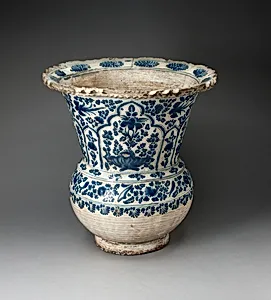
Jardinière
1700–75
Medium
Tin-glazed earthenware
Dimensions
44 × 41.9 cm (17 1/4 × 16 1/2 in.)
Classification
earthenware
Department
Arts of the Americas
Museum
Art Institute of Chicago
Accession Number
10545
Rights
Public Domain
Art Historical Context
This elegant *Jardinière*, a planter from the Talavera Poblana workshops of colonial Mexico (1700–75), exemplifies the vibrant tin-glazed earthenware tradition that flourished in Puebla during the Viceroyalty of New Spain Measuring 44 × 41.9 cm, this piece was designed to hold ornamental plants, blending utility with opulent decoration in a time when such ceramics graced the homes of the elite. Talavera Poblana pottery drew from Spanish majolica techniques introduced in the 16th century but evolved with Mexican flair, incorporating bold cobalt blues, yellows, and floral motifs inspired by both European Renaissance designs and local flora. The tin glaze created a luminous white surface ideal for intricate hand-painted patterns, fired at low temperatures to preserve vivid metallic oxide colors—a labor-intensive process symbolizing skilled craftsmanship amid colonial trade networks. Housed in the Art Institute of Chicago's Arts of the Americas department, this jardinière highlights the cultural fusion of Spanish, indigenous, and Asian influences in New World art. It reflects Pobla's role as a pottery hub, where workshops like those of the Talavera masters produced luxury goods that bridged Old and New Worlds, offering visitors a tangible glimpse into 18th-century colonial splendor.