
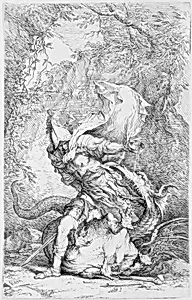
Jason and the Dragon
ca. 1663–64
Medium
Etching and drypoint
Dimensions
sheet: 13 7/16 x 8 1/2 in. (34.1 x 21.6 cm)
Classification
Prints
Department
Drawings and Prints
Museum
Metropolitan Museum of Art, New York, NY
Credit
Purchase, Joseph Pulitzer Bequest, 1917
Accession Number
17.50.17-86
Rights
Public Domain
Tags
Art Historical Context
Behold *Jason and the Dragon*, a captivating etching and drypoint by the Italian Baroque master Salvator Rosa, created around 1663–64. Rosa, a flamboyant 17th-century artist from Naples renowned for his dramatic landscapes and theatrical compositions, drew inspiration from classical mythology here. The scene captures the heroic moment from the Argonaut legend when Jason confronts the fearsome dragon guarding the Goldenleece, surrounded by twisted trees that heighten the tension. Rosa's proto-Romantic style infuses the work with wild energy and emotional intensity, bridging Baroque grandeur with emerging individualism. Masterfully executed in etching—where acid etches intricate lines into a copper plate—and drypoint, which adds velvety, burr-rich textures for depth and drama, this print exemplifies Rosa's innovative printmaking prowess. At 13 7/16 x 8 1/2 inches, its intimate scale invites close viewing, revealing the artist's virtuoso linework that conveys fury, scale, and shadow. Produced late in his career, it reflects Rosa's fascination with heroic strife and the sublime forces of nature, influencing later Romantic artists. Acquired by The Metropolitan Museum of Art in 1917 through the Joseph Pulitzer Bequest, this rarity from the Drawings and Prints department offers a window into 17th-century Italy's vibrant print culture, where myths were reimagined for enlightened collectors. A thrilling blend of myth and mastery!
About the Artist
Salvator Rosa · 1615–1673
Salvator Rosa was born in 1615 in Arenella, on the outskirts of Naples, into a world of artistic ambition and turbulent talent. His early training came through his maternal uncle, the painter Paolo Greco, and his brother-in-law Francesco Fracanzano, himself a pupil of the great Spanish-born Neapolitan master Jusepe de Ribera. Rosa showed a fierce independence from the start, resisting his father's...