
"Jay Eye See" Driving Bit
1940
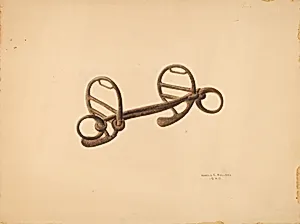
Medium
watercolor and graphite on paper
Dimensions
overall: 26.7 x 35.8 cm (10 1/2 x 14 1/8 in.) Original IAD Object: ends: 3 1/2" high; 2 1/4" wide; bit bars: 5 1/2" long; rein rings: 1 1/4" in diameter
Classification
Index of American Design
Department
CG-W
Museum
National Gallery of Art, Washington, D.C.
Credit
Index of American Design
Accession Number
1943.8.9003
Rights
Public Domain
Art Historical Context
Visitors to the National Gallery of encounter *Jay Eye See* Driving Bit, a meticulous 1940 watercolor and rendering on paper by artist Harold Ballerd. Measuring 26.7 x 35.8 cm, this work depicts a specialized equestrian bit—its ends rising 3½ inches high and 2¼ inches wide with 5½-inch bit bars and 1¼-inch rein—designed for harness racing or driving horses. Part of the esteemed Index of American Design (AD), it captures the intricate craftsmanship of early 20th-century American horse tack with precise detail and subtle shading. Created under the Works Progress Administration's Federal Art Project (1935–1942), the IAD commissioned artists like Ballerd to document everyday American folk objects, preserving cultural heritage through vibrant yet accurate reproductions. Watercolor lent luminous color to the bit's metallic sheen and leather elements, while graphite added fine lines for texture and form, highlighting functional design born from equestrian traditions. This piece evokes the thrill of America's harness racing era, where bits like the "Jay Eye See"—likely named for the legendary 1880s champion trotter Jay-eye-see—enabled speed and control. Ballerd's artwork bridges utility and artistry, inviting us to appreciate how everyday tools shaped national pastimes and identity.