
Jean-Baptiste Rousseau
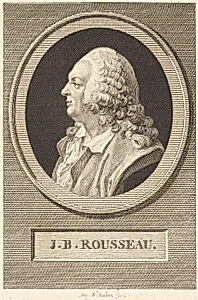
Medium
engraving over etching on laid paper
Dimensions
plate: 17.3 x 11.5 cm (6 13/16 x 4 1/2 in.) sheet: 17.3 x 13.6 cm (6 13/16 x 5 3/8 in.)
Classification
Department
CG-E
Museum
National Gallery of Art, Washington, D.C.
Credit
Gift of John O'Brien
Accession Number
1986.88.25
Rights
Public Domain
Art Historical Context
Discover the elegant portrait *Jean-Baptiste Rousseau* (1802), an engraving over etching by the skilled French printmaker Augustin de Saint-A. This intimate work captures the likeness of the celebrated 18th-century poet, dramatist, and librett Jean-Baptiste Rousseau (16711741), whose witty verses and operas graced the salons of Louis XIV's Versailles. Created over six decades after Rousseau's death, it reflects the enduring fascination with Enlightenment figures during the Napoleonic era, when nostalgia for pre-Revolutionary cultural icons surged. Saint-Aubin's mastery shines in his mixed technique: etching provides fluid, spontaneous lines for the subject's expressive face and flowing wig, while fine engraving adds precise details to clothing and background shading. Printed on laid paper—a traditional support with visible chain lines that evokes 18th-century craftsmanship—the modest plate (17.3 x 11.5 cm) yields a refined, reproducible image ideal for collectors and scholars. Housed in the National Gallery of Art's print collection (gift of John O'Brien), this piece highlights the print's role in democratizing portraiture, bridging elite portrait painting with wider audiences. A testament to Saint-Aubin's legacy in the French Rococo-to-Neoclassical transition, it invites you to ponder Rousseau's quill-sharp legacy amid post-Revolutionary France.
About the Artist
Augustin de Saint-Aubin · 1736–1807
Comment on works: Illustrator; Engraver