
Jean-Charles-Philibert Trudaine
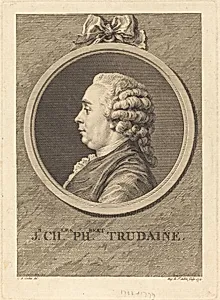
Medium
etching on laid paper
Dimensions
plate: 19.3 x 13.8 cm (7 5/8 x 5 7/16 in.) sheet: 20.8 x 14.9 cm (8 3/16 x 5 7/8 in.)
Classification
Department
CG-E
Museum
National Gallery of Art, Washington, D.C.
Credit
Gift of John O'Brien
Accession Number
1989.84.13
Rights
Public Domain
Art Historical Context
This delicate etching portrays Jean-Charles-Philibert Trudaine, a prominent French figure of the Enlightenment era, captured in 1774 by master engraver Augustin de Saint-Aubin after an original design by Charles-Nicolas Cochin II. Cochin II, a leading artist under Louis XV, was renowned for his refined line work and contributions to French printmaking, bridging Rococo elegance with emerging Neoclassical precision. Saint-Aubin's faithful reproduction honors this legacy, transforming a preparatory drawing into a widely distributable print. Etched on laid paper—a textured support prized for its subtle chain lines that enhance ink retention—the small plate (19.3 x 13.8 cm) exemplifies 18th-century intaglio techniques. Etching allowed artists like Saint-Aubin to achieve intricate details and tonal subtlety through acid-bitten lines, making fine portraits accessible beyond elite circles. Produced on the eve of the French Revolution, it reflects the era's fascination with enlightened administrators like Trudaine, who advanced infrastructure and reform. Now in the National Gallery of Art's collection through the generous gift of John O'Brien, this print invites us to appreciate how 18th-century engraving democratized portraiture, preserving the likenesses of influential lives for posterity.