
Jean-Francois Millet
1856–58
Medium
Salted paper print from paper negative
Dimensions
Mount: 15 7/8 in. × 11 5/8 in. (40.4 × 29.5 cm) Image: 10 9/16 × 8 3/8 in. (26.8 × 21.3 cm)
Classification
Photographs
Department
Photographs
Museum
Metropolitan Museum of Art, New York, NY
Credit
Bequest of Maurice B. Sendak, 2012
Accession Number
2013.159.46
Rights
Public Domain
Tags
Art Historical Context
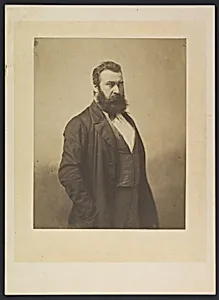
Step into the world of 19th-century with Nadar's captivating portrait of Jean-François Millet created between 1856 and 1858. Nadar, the pseudonym of Gaspard-Félix Tournachon, was a master photographer renowned for immortalizing the era's intellectuals, artists, and bohemians. Here, he captures Millet, the pioneering Realist painter famous for his empathetic depictions of rural peasant life, such as *The Gleaners*. This salted paper print from a paper negative—dimensions of the image measuring about 10½ by 8⅜ inches—exemplifies early photographic innovation, where light-sensitive paper negatives allowed for detailed, tonal prints with a soft, painterly quality. Produced during photography's formative years, this work highlights the medium's growing role in portraiture, rivaling traditional painting. The calotype process, akin to this salted paper technique, was championed by pioneers like William Henry Fox Talbot, enabling artists like Nadar to blend technical precision with artistic vision. Millet's intense gaze and rugged features convey the determination of a man revolutionizing French art through the Barbizon School's focus on nature and everyday labor. Today, housed in the Metropolitan Museum of Art thanks to the 2012 bequest of Maurice B. Sendak, this photograph bridges photography's technical dawn with the humanist spirit of Realism, offering visitors a poignant glimpse into two visionaries' worlds.