
Jean Le Camus
1674
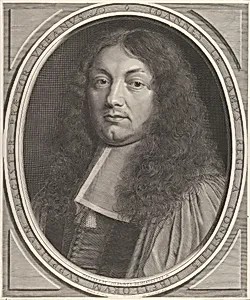
Medium
Engraving; second state of three (Petitjean & Wickert)
Dimensions
Sheet: 17 15/16 × 14 15/16 in. (45.5 × 38 cm)
Classification
Prints
Department
Drawings and Prints
Museum
Metropolitan Museum of Art, New York, NY
Credit
Gift of Mr. Lev Tsitrin, 2001
Accession Number
2001.647.64
Rights
Public Domain
Tags
Art Historical Context
In the opulent era of Louis XIV's France, Robert Nanteuil crafted this striking portrait engraving of *Jean Le Camus* in1674. Nanteuil (1623–1678), one of the era's premier engravers and the king's official portraitist, mastered the burin to capture the nobility and character of his sitters with unparalleled finesse. This second state of three—referenced in the authoritative catalogue by Petitjean and Wickert—shows the plate in a refined phase, where intricate lines convey texture, from the curl of Le Camus's wig to the subtle folds of his lace collar. Measuring nearly 18 by 15 inches, the large sheet allowed Nanteuil to showcase his Baroque precision, blending realism with grandeur typical of 17th-century French printmaking. Engravings like this democratized elite portraiture, disseminating images of financiers, courtiers, and intellectuals like Le Camus—likely a prominent Parisian figure—across Europe. The technique's durability ensured lasting impressions, making it a cornerstone of reproductive art. Today, this generous gift to The Metropolitan Museum of Art in 2001 invites visitors to appreciate how Nanteuil elevated printmaking to fine art, bridging the intimacy of drawing with the power of public dissemination.
About the Artist
Robert Nanteuil · 1623–1678
Robert Nanteuil (1623-1678) was a French portrait engraver, draughtsman, and pastellist who became the preeminent portraitist to the court of Louis XIV. His technical mastery and royal patronage fundamentally transformed the status of engraving in France, elevating it from a mechanical craft to a recognized fine art. Nanteuil stands as the outstanding French portrait engraver of the seventeenth c...