
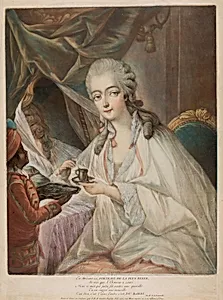
Jeanne Bécu, Comtesse Du Barry, and her servant Zamor
Medium
Color aquatint, hand applied opaque white and embossing on laid paper
Dimensions
Plate: 39.9 × 31.2 cm (15 3/4 × 12 5/16 in.); Sheet: 44.7 × 33.6 cm (17 5/8 × 13 1/4 in.)
Classification
aquatint
Department
Prints and Drawings
Museum
Art Institute of Chicago
Accession Number
61073
Rights
Public Domain
About this artwork
The artists of the Gautier D’Agosty family experimented with several approaches to color printing. In the attempt to make what they called “printed paintings”, they sometimes even varnished their final results. This aquatint is not only printed in full color from multiple plates, but the lace bordering Madam du Barry’s negligée has been deeply embossed in a painterly impasto manner. The accompanying poem suggest fawningly that this royal mistress in her boudoir is indistinguishable from Venus, t...
Art Historical Context
This striking color aquatint captures Jeanne Bécu, the Comtesse Du Barry, the influential mistress of King Louis XV alongside her young servant Zamor in 1771. Created just years before the French Revolution, the print reflects the opulence and exoticism of the late French court, where figures like Du Barry embodied both glamour and social controversy. Zamor, depicted as a page, adds a layer of cultural fascination with distant lands that was common in aristocratic portraiture of the period. Jean Baptiste André Gautier d'Agoty employed the innovative medium of color aquatint, enhanced with hand-applied opaque white and embossing on laid paper. This technique allowed for soft tonal gradations and luminous effects that mimicked painting, elevating the print from mere reproduction to a luxurious object. Such methods were at the forefront of 18th-century graphic arts, bridging traditional engraving with the emerging possibilities of color printing. Housed in the Art Institute of Chicago’s Prints and Drawings department, the work exemplifies how aquatint expanded artistic expression during the Rococo era, offering viewers intimate access to celebrated personalities through refined, accessible imagery.