
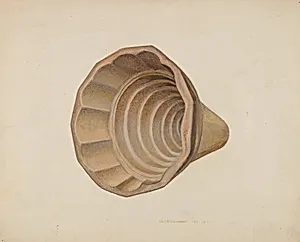
Jelly Mold
c. 1940
Medium
watercolor, gouache, colored pencil, and graphite on paperboard.
Dimensions
overall: 28 x 22.5 cm (11 x 8 7/8 in.)
Classification
Index of American Design
Department
CG-W
Museum
National Gallery of Art, Washington, D.C.
Credit
Index of American Design
Accession Number
1943.8.5103
Rights
Public Domain
Art Historical Context
**Jelly Mold** by H. Alexander, created around 1940, is a rendering from the *Index of American Design*, landmark WPA Federal Art Project (1935–1942). This ambitious initiative employed artists across the U.S. to document everyday American folk art and decorative objects through precise, colorful watercolor studies, preserving cultural heritage during the Great Depression. Alexander's work captures the humble yet elegant form of a jelly mold—a common household item used for shaping translucent desserts in 19th- and early 20th-century American kitchens—highlighting the ingenuity of vernacular design. Rendered in watercolor, gouache, colored pencil, and graphite on paperboard (28 x 22.5 cm), the piece showcases meticulous technique: gouache provides opaque vibrancy for metallic sheen and intricate patterns, while colored pencil adds fine details to textures like embossed motifs or fluted edges. This mixed-media approach exemplifies the Index's goal of faithful reproduction, blending artistic skill with documentary accuracy to elevate utilitarian objects into icons of national identity. Today, housed in the National Gallery of Art's collection, *Jelly Mold* reminds us of America's rich tradition of functional artistry, evoking nostalgia for domestic rituals and the WPA's role in fostering creativity amid hardship. A delightful glimpse into everyday elegance! (198 words)