
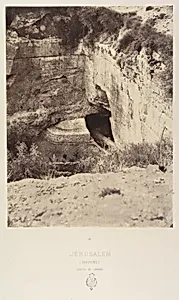
Jérusalem. (Environs) Grotte de Jérémie
1860 or later
Medium
Albumen silver print from paper negative
Dimensions
Image: 11 in. × 8 1/4 in. (28 × 21 cm) Mount: 17 15/16 × 23 1/4 in. (45.5 × 59 cm)
Classification
Photographs
Department
Photographs
Museum
Metropolitan Museum of Art, New York, NY
Credit
Gilman Collection, Gift of The Howard Gilman Foundation, 2005
Accession Number
2005.100.500.3 (23)
Rights
Public Domain
Tags
Art Historical Context
Step into the ancient environs of Jerusalem with *Jérusalem. (Environs) Grotte de Jérémie*, a captivating 1860s albumen silver print by Louis de Clercq, in collaboration with H. Jann, J. Blondeau, and Antonin. This landscape photograph immortalizes the rugged Grotte de Jérémie—Jeremiah's Grotto—a site traditionally linked to the biblical prophet's lamentations amid the city's rocky outskirts. De Clercq, a pioneering French photographer and traveler, documented the Holy Land during a period of fervent European interest in biblical archaeology and Orientalism. Crafted as an albumen silver print from a paper negative, the image exemplifies mid-19th-century photographic innovation. Albumen, derived from egg whites, coated the paper to produce sharp details and warm, luminous tones that brought distant landscapes vividly to life—far surpassing earlier daguerreotypes. Measuring 11 × 8¼ inches on a grand 18 × 23-inch mount, it was designed for collectors' albums, blending artistry with scientific precision. Housed in the Metropolitan Museum of Art's Gilman Collection, this print offers a window into 19th-century exploration, preserving a sacred site untouched by modern development. It reminds us how photography bridged East and West, fueling Romantic fascination with antiquity and faith.