
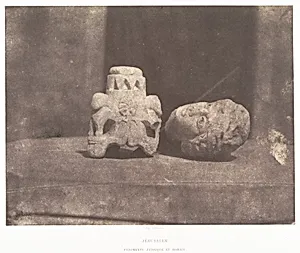
Jérusalem, Fragments judaïque et romain
Medium
Salted paper print from paper negative
Dimensions
Image: 23.5 x 30.9 cm (9 1/4 x 12 3/16 in.) Mount: 44.8 x 59.7 cm (17 5/8 x 23 1/2 in.)
Classification
Photographs
Department
Photographs
Museum
Metropolitan Museum of Art, New York, NY
Credit
Gilman Collection, Gift of The Howard Gilman Foundation, 2005
Accession Number
2005.100.373.74
Rights
Public Domain
Art Historical Context
In 1854, French photographer Auguste Salzmann captured timeless layers of Jerusalem in *Jérusalem, Fragmentsïque et romain*, salted paper print from a paper negative. This evocative image reveals archaeological remnants—Judaic and Roman fragments—juxtaposed amid the city's enduring sacred landscape. Salzmann's journey to the Holy Land in 185–54 was driven by a passion for documenting biblical sites and ancient ruins, making his work a visual bridge between 19th-century Europe and antiquity. Printed by the innovative Imprimerie photographique de Blanquart-Évrard in Lille, the photograph employs the calotype process, where a paper negative yields soft, textured positives prized for their painterly depth. This early technique, perfected in the 1840s, allowed for multiple prints from a single negative, revolutionizing photography's role in preservation and dissemination. Salzmann's image holds profound cultural weight, offering a rare pre-modern glimpse of Jerusalem's stratified history under Ottoman rule. Housed in the Metropolitan Museum of Art's Gilman Collection, it underscores photography's emergence as an archaeological tool, blending art, faith, and science to inspire awe in visitors today. (198 words)
About the Artist
Auguste Salzmann|Imprimerie photographique de Blanquart-Évrard, à Lille · 1824–1872
Born 15 april 1824. Salzmann travelled to Palestine in 1850 to 1851 as a draughtsman for a French expedition to the East. Salzmann returned to Paris, France in 1851 and learned photography which he used as an aid to his archaeological research. In 1853 Salzmann was commissioned by the Ministry of Public Instruction to visit Egypt, Syria, Palestine, and the islands of the Archipelago to photograph ...