
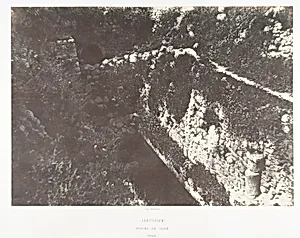
Jérusalem, Piscine de Siloe, Détails
Medium
Salted paper print from paper negative
Dimensions
Image: 23.5 x 33.3 cm (9 1/4 x 13 1/8 in.) Mount: 44.7 x 60.2 cm (17 5/8 x 23 11/16 in.)
Classification
Photographs
Department
Photographs
Museum
Metropolitan Museum of Art, New York, NY
Credit
Gilman Collection, Gift of The Howard Gilman Foundation, 2005
Accession Number
2005.100.373.35
Rights
Public Domain
Tags
Art Historical Context
In 1854, French photographer Auguste Salzmann captured ancient ruins of the Piscine de Siloe (Pool of Siloam) in Jerusalem with this salted paper print, produced by the renowned Imprimerie photographique deanquart-Évrard in Lille. The image focuses on intricate architectural details of the site's weathered stones and steps, evoking the biblical where, according to the Gospel of John, Jesus healed a blind man. Salzmann's expedition to the Holy Land amid mid-19th-century political tensions marked one of the earliest photographic documentations of these sacred sites, blending archaeology with emerging visual technology. Printed from a paper negative using the calotype process—a pioneering technique perfected by pioneers like Louis-Napoléon Blanquart-Évrard—this medium yields a soft, painterly quality with rich tonal depth. Salted paper prints, popular in the 1840s and 1850s, allowed for multiple positives from a single negative, making photography more accessible and reproducible. The large mount (44.7 x 60.2 cm) emphasizes its role as a grand, study-worthy artifact. Now in the Metropolitan Museum of Art's Gilman Collection, this work highlights photography's power to preserve vanishing ruins and bridge art with history, inviting visitors to ponder Jerusalem's layered past through a 19th-century lens.
About the Artist
Imprimerie photographique de Blanquart-Évrard, à Lille|Auguste Salzmann ( |French) · |1851 – |1855
French|French, active 1851–55