
Jérusalem, Porte de Jaffa, Inscription
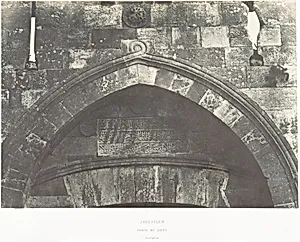
Medium
Salted paper print from paper negative
Classification
Photographs
Department
Photographs
Museum
Metropolitan Museum of Art, New York, NY
Credit
Gilman Collection, Gift of The Howard Gilman Foundation, 2005
Accession Number
2005.100.373.138
Rights
Public Domain
Tags
Art Historical Context
In 1854, French photographer Auguste Salzmann capturedJérusalem, Porte Jaffa, Inscription a poignant salted paper print from a paper negative, showcasing iconic Jaffa Gate in Jerusalem's Old City walls. This entrance, a vital passage for pilgrims and traders, features an inscription that highlights the city's layered history under Ottoman rule. Salzmann's journey to the Holy Land amid the Crimean War tensions made his images rare early photographic records of sacred architecture, preserving architectural details like arches and stonework before modern changes. Printed by the innovative Imprimerie photographique de Blanquart-Évrard in Lille, the work employs the calotype process—pioneered by William Henry Fox Talbot—where a paper negative yields warm-toned positives with subtle textures. This medium was revolutionary for its portability, allowing Salzmann to document remote sites without bulky studios, bridging art and archaeology. Today, part of the Met's Gilman Collection, this print invites visitors to ponder Jerusalem's enduring allure, blending 19th-century photographic innovation with timeless cultural heritage. (178 words)
About the Artist
Auguste Salzmann|Imprimerie photographique de Blanquart-Évrard, à Lille · 1824–1872
Born 15 april 1824. Salzmann travelled to Palestine in 1850 to 1851 as a draughtsman for a French expedition to the East. Salzmann returned to Paris, France in 1851 and learned photography which he used as an aid to his archaeological research. In 1853 Salzmann was commissioned by the Ministry of Public Instruction to visit Egypt, Syria, Palestine, and the islands of the Archipelago to photograph ...