
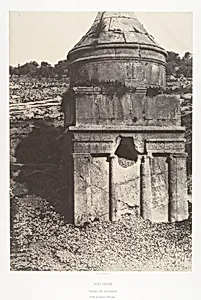
Jérusalem, Vallée de Josaphat, Détails du Tombeau d'Absalom
Medium
Salted paper print from paper negative
Dimensions
Image: 33 x 23.1 cm (13 x 9 1/8 in.) Mount: 60 x 44.6 cm (23 5/8 x 17 9/16 in.)
Classification
Photographs
Department
Photographs
Museum
Metropolitan Museum of Art, New York, NY
Credit
Gilman Collection, Gift of The Howard Gilman Foundation, 2005
Accession Number
2005.100.373.47
Rights
Public Domain
Tags
Art Historical Context
In 1854, French photographer Auguste Salzmann capturedJérusalem, Vall de Josaphat, Détails du Tombeau'Absalom* (Jerusalem, Valley of Jehaphat, Details of Tomb of Absalom), exquisite salted paper print made from a paper negative. intimate study focuses on the intricate stone carvings and weathered ruins of the ancient tomb, a Second Temple-era monument in Jerusalem's sacred Kidron Valley, long associated with biblical narratives. Produced by the renowned Imprimerie photographique de Blanquart-Évrard in Lille, the image measures 33 x 23.1 cm and exemplifies early calotype photography's soft tonal range and fine detail. Salzmann's journey to the Holy Land that year was pioneering; he documented Jerusalem's monuments to preserve their fading splendor amid 19th-century exploration and decay. As one of the first photographers to systematically record these sites, his work bridged archaeology, history, and faith, offering Western audiences unprecedented views of biblical landscapes without travel's perils. This print's salted paper technique—sensitive to light yet prone to fading—highlights photography's nascent role in cultural documentation. Housed in the Metropolitan Museum of Art's Gilman Collection, it invites visitors to ponder the tomb's enduring mystery, where ornate Ionic columns whisper tales from antiquity.
About the Artist
Auguste Salzmann|Imprimerie photographique de Blanquart-Évrard, à Lille · 1824–1872
Born 15 april 1824. Salzmann travelled to Palestine in 1850 to 1851 as a draughtsman for a French expedition to the East. Salzmann returned to Paris, France in 1851 and learned photography which he used as an aid to his archaeological research. In 1853 Salzmann was commissioned by the Ministry of Public Instruction to visit Egypt, Syria, Palestine, and the islands of the Archipelago to photograph ...