
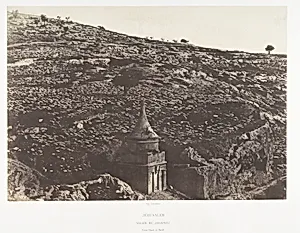
Jérusalem, Vallée de Josaphat, Faces Ouest et Nord, 1
Medium
Salted paper print from paper negative
Dimensions
Image: 22.8 x 32.8 cm (9 x 12 15/16 in.) Mount: 44.5 x 60.4 cm (17 1/2 x 23 3/4 in.)
Classification
Photographs
Department
Photographs
Museum
Metropolitan Museum of Art, New York, NY
Credit
Gilman Collection, Gift of The Howard Gilman Foundation, 2005
Accession Number
2005.100.373.41
Rights
Public Domain
Tags
Art Historical Context
Step into the ancient heart of Jerusalem with *Jérusalem, Vall de Josaphat, Ouest et Nord, 1* (1854), a pioneering salted paper print by Auguste Salzmann, produced at the Imprimerie photographique de Blart-Évrard in Lille. This evocative image captures the west and north faces of the of Jehoshaphat biblical site steeped in prophecy, believed by some to be the location of the Last Judgment. Salzmann, a French surgeon-turned-photographer, ventured to the Holy Land in 1853–54, creating one of the earliest systematic photographic records of its sacred landscapes and architecture. In the dawn of photography, this 22.8 x 32.8 cm print exemplifies the calotype process, using a paper negative to yield soft, textured tones that convey the valley's timeless stone facades and rugged terrain. Printed by Louis-Désiré Blanquart-Évrard, a master of salted paper techniques, it showcases innovations in stability and detail that made mass production of high-quality photographs possible. Salzmann's work bridged art and archaeology, offering 19th-century viewers unprecedented access to distant holy sites. Today, housed in The Metropolitan Museum of Art's Gilman Collection, this photograph invites us to ponder Jerusalem's enduring spiritual resonance through the lens of early photographic artistry.
About the Artist
Imprimerie photographique de Blanquart-Évrard, à Lille|Auguste Salzmann ( |French) · |1851 – |1855
French|French, active 1851–55