
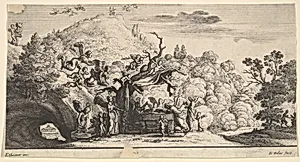
Jesus served by angels
Medium
Etching; only state
Dimensions
Sheet: 3 5/8 × 6 15/16 in. (9.2 × 17.6 cm) cut within image
Classification
Prints
Department
Drawings and Prints
Museum
Metropolitan Museum of Art, New York, NY
Credit
Purchase, Joseph Pulitzer Bequest, 1917
Accession Number
17.50.18-156
Rights
Public Domain
Tags
Art Historical Context
This delicate etching, *Jesus Served by Angels* (1652), is a reproductive print by the masterful Bohemian etcher Wenceslaus Hol after an original composition by German Baroque painter Adam Elsheimer It captures a pivotal biblical moment from Matthew 4:11, where angels minister to Christ in the wilderness following his temptation by Satan. The intimate scene unfolds amid rugged caves and slender trees, emphasizing themes of divine comfort and spiritual renewal in a compact format—measuring just 3 5/8 × 6 15/16 inches, and notably cut within the image borders. Hollar's etching, in its only known state, showcases his virtuosic technique in translating Elsheimer's luminous, jewel-like original into intricate lines that evoke texture and depth on a tiny scale. Etching allowed for precise rendering of foliage, rocky caverns, ethereal angel wings, and Christ's serene figure, making complex religious narratives accessible through printmaking—a revolutionary medium in the 17th century for disseminating art beyond elite patrons. Acquired by The Metropolitan Museum of Art in 1917 through the Joseph Pulitzer Bequest, this print highlights the era's fusion of Northern European precision with Baroque drama. Visitors will appreciate its role in preserving Elsheimer's innovative style, which influenced later masters like Rembrandt, bridging painting and print traditions.
About the Artist
Adam Elsheimer|Wenceslaus Hollar · 1578–1610
Elsheimer's meticulously detailed small paintings on copper would establish him as the most influential artist to follow Albrecht Dürer. He most likely arrived in Italy ca. 1598, where he quite possibly was associated with Hans Rottenhammer, and then moved to Rome in 1600, where he remained until his death. Comment on works: Landscapes; Religious.