
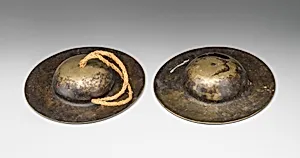
Jhyālī
Unknown Artist
19th century
Medium
Brass
Dimensions
Diam.: 22.5 cm (8-7/8 in.); Depth.: 4.6 cm (1-13/16 in.)
Classification
Idiophone-Concussion
Culture
Nepalese
Department
Musical Instruments
Museum
Metropolitan Museum of Art, New York, NY
Credit
Gift of Krishna Man Manandhar, 1986
Accession Number
1986.352.5
Rights
Public Domain
Art Historical Context
Nestled in the Metropolitan Museum of Art's Department of Musical Instruments, this 19th-century *Jhyālī* from Nepal exemplifies the artistry of traditional craftsmanship. Fashioned from brass, this pair of small, shallow discs measures 22.5 cm in diameter 4.6 cm in depth, making it perfectly suited for handheld performance. As an idiophone-concussion instrument, it produces its resonant, shimmering sound when the two discs are struck together, a technique that demands skill to create varied rhythms and tones. In Nepalese culture, *jhyālī* like this one played a vital role in folk, devotional, and ceremonial music, often accompanying ensembles during festivals, rituals, and dances. The 19th century marked a period when such instruments were integral to Newar community traditions in the Kathmandu Valley, blending everyday utility with spiritual expression. Brass, valued for its durability and rich timbre, was meticulously worked—likely hammered and polished—to achieve both acoustic precision and aesthetic appeal. Generously gifted by Krishna Man Manandhar in 1986, this *jhyālī* invites visitors to imagine the lively pulse of Himalayan celebrations, where sound bridges the earthly and divine. Though the artist remains unknown, the object's survival highlights the enduring legacy of Nepal's sonic heritage.