
John Beale Bordley
c. 1770
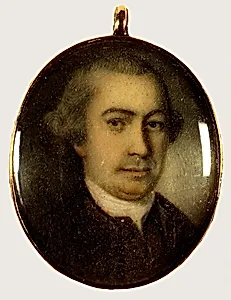
Medium
watercolor on ivory
Dimensions
overall (oval): 3.5 x 3 cm (1 3/8 x 1 3/16 in.)
Classification
Drawing
Department
CG-W
Museum
National Gallery of Art, Washington, D.C.
Credit
Gift of The Barra Foundation, Inc.
Accession Number
1986.78.1
Rights
Public Domain
Art Historical Context
Step into the intimate world of 18th-century portraiture *John Beale Bordley*, a delicate watercolor on ivory miniature painted around 1770 by Charles Will Peale. This oval, measuring just 3.5 x 3 cm, captures the of Bordley, a prominent Maryland planter, agricultural reformer, and patriot who championed crop rotation and supported the American Revolution. Peale, a Founding Father of American art, rendered Bordley with lifelike precision, his gaze direct and dignified against a subtle background, evoking the Enlightenment ideals of reason and civic virtue. Watercolor on ivory was the medium of choice for these tiny treasures, prized for their luminous translucency and portability—often worn as jewelry or kept in lockets as personal mementos. Peale's mastery of this technique, honed through study in London, highlights his versatility beyond large-scale oils; he was a polymath who painted George Washington and founded America's first public museum. This work exemplifies the genteel miniature tradition, bridging European refinement with emerging colonial identity. Today, housed in the National Gallery of Art as a gift from The Barra Foundation, *John Beale Bordley* offers a window into pre-Revolutionary elite society, where art preserved legacies in the palm of one's hand. A testament to Peale's enduring legacy, it reminds us how small-scale brilliance captured big historical moments.
About the Artist
Charles Willson Peale · 1741–1827
Charles Willson Peale (1741–1827) was an American painter, museum founder, naturalist, and inventor who became the most important American portraitist of the Revolutionary era and a central figure in the cultural life of the young republic. Born in Queen Anne's County, Maryland, he initially trained as a saddler before turning to painting, studying briefly with John Singleton Copley in Boston and ...