
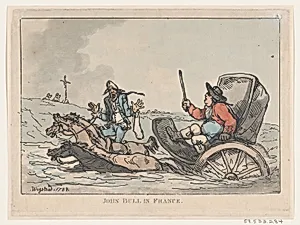
John Bull in France
Medium
Hand-colored etching and aquatint
Dimensions
Sheet: 7 3/16 × 9 3/4 in. (18.3 × 24.7 cm)
Classification
Prints
Department
Drawings and Prints
Museum
Metropolitan Museum of Art, New York, NY
Credit
The Elisha Whittelsey Collection, The Elisha Whittelsey Fund, 1959
Accession Number
59.533.284
Rights
Public Domain
Tags
Art Historical Context
Created in 1788 by the British artists Thomas Rowlandson and Henry Wigstead, *John Bull in France* offers a lively glimpse into late-eighteenth-century travel and national stereotypes. Rowlandson, celebrated for his sharp caricatures, frequently collaborated with Wigstead to produce satirical prints that captured the foibles of society. Here, the familiar figure of John Bull—the stout embodiment of England—ventures abroad, highlighting the cultural clashes and comic mishaps that British tourists often encountered on the Continent. Executed as a hand-colored etching and aquatint, the work exemplifies the vibrant print culture of Georgian Britain. This affordable medium allowed satirical images to circulate widely, blending fine line work with delicate washes of color to emphasize humorous details such as exaggerated expressions and period carriages. The print’s modest size made it suitable for private collections, where viewers could enjoy its witty commentary from the comfort of home. Today housed in the Metropolitan Museum of Art, *John Bull in France* remains a delightful example of how caricature served both entertainment and social observation during an era of expanding travel and shifting political relations between Britain and France.
About the Artist
Thomas Rowlandson|Henry Wigstead · 1756–1827
Thomas Rowlandson (1757–1827) was an English artist and caricaturist whose satirical watercolors and prints captured the social life of Georgian Britain with unparalleled wit and technical mastery. Alongside James Gillray, he is recognized as one of the greatest British graphic artists, and his distinctive flowing line and keen observations have made his work integral to understanding late 18th an...