
John Flaxman
published 1823
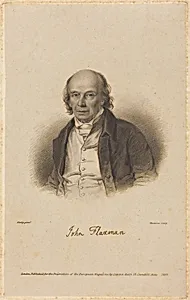
Medium
stipple engraving on papier colle
Dimensions
sheet: 23.8 × 17 cm (9 3/8 × 6 11/16 in.)
Classification
Department
CG-E
Museum
National Gallery of Art, Washington, D.C.
Credit
Rosenwald Collection
Accession Number
1980.45.1780
Rights
Public Domain
Art Historical Context
This stipple engraving titled "John Flaxman," published in 1823, represents a fine example of early nineteenth-century reproductive printmaking. Created by James after a drawing by William Derby, the small-scale work measures 23.8 × 17 cm and employs the stipple technique—building tones and textures through countless tiny dots—to render a sensitive portrait. Mounted on papier collé, the print combines precision with a subtle, layered surface that was valued for both aesthetic and practical reasons during this period. Stipple engravings like this one played an important role in disseminating images of notable figures to wider audiences before photography. The collaborative process, in which an engraver interpreted another artist’s drawing, highlights the specialized skills involved in translating line and tone into print. Such works were often issued in series or books, helping to preserve likenesses and artistic reputations for posterity. Part of the National Gallery of Art’s Rosenwald Collection, the engraving offers visitors a glimpse into the technical artistry and cultural circulation of portraiture in the 1820s.