
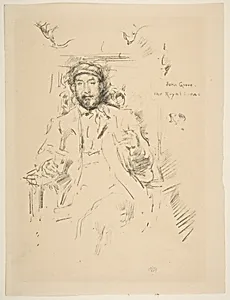
John Grove
Medium
Transfer lithograph; only state (Chicago); printed in black ink on cream machine-made wove
Dimensions
Image: 8 1/8 × 6 1/16 in. (20.7 × 15.4 cm) Sheet: 9 15/16 × 7 1/2 in. (25.2 × 19.1 cm)
Classification
Prints
Department
Drawings and Prints
Museum
Metropolitan Museum of Art, New York, NY
Credit
Harris Brisbane Dick Fund, 1917
Accession Number
17.3.231
Rights
Public Domain
Tags
Art Historical Context
James McNeill Whistler’s *John Grove* (1895) is a striking transfer lithograph capturing the essence of its sitter, an unidentified man whose thoughtful gaze and relaxed pose evoke quiet introspection. Printed in black ink on cream machine-made wove paper, intimate portrait measures just over 8 by 6 inches, showcasing Whistler’s mastery of reductive techniques in the medium. As a transfer lithograph—the only state produced in Chicago—the image was drawn on transfer paper before being offset onto a lithographic stone, allowing for the fluid, painterly lines and subtle tonal gradations that mimic his celebrated etchings. Whistler, a leading figure in the Aesthetic movement, championed “art for art’s sake,” prioritizing harmony of color, form, and mood over narrative. By the 1890s, late in his career, he had refined lithography as a democratic yet sophisticated medium, producing affordable prints that rivaled paintings in subtlety. This work exemplifies his portraiture’s psychological depth, rendered with economical strokes that suggest rather than delineate, influencing modern printmakers. Acquired in 1917 through the Harris Brisbane Dick Fund and housed in The Metropolitan Museum of Art’s Drawings and Prints department, *John Grove* offers visitors a window into fin-de-siècle portraiture, blending technical innovation with Whistler’s enduring pursuit of beauty.
About the Artist
James McNeill Whistler · 1834–1903
James Abbott McNeill Whistler (1834-1903) was an American-born painter and printmaker who became a leading figure in the Aesthetic Movement and pioneer of Tonalism and Japonisme. He revolutionized art by championing "art for art's sake" and treating paintings as visual equivalents of musical compositions, titling works as "arrangements," "harmonies," and "nocturnes" to emphasize formal qualities o...