
Medium
Classification
Department
Smithsonian Collection
Museum
Smithsonian American Art Museum
Credit
National Portrait Gallery, Smithsonian Institution; gift of Mr. and Mrs. Paul Mellon
Accession Number
S/NPG.74.39.15.3
Rights
Public Domain
Tags
Art Historical Context
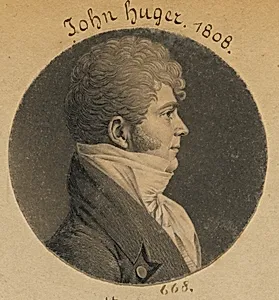
**John Huger (1808)** *Charles Balthazar Julien Fret de Saint-Mé (1770–1852)* This elegant print portrays John Huger, a prominent Carolina planter and politician who served in the U.S. House of Representatives from 1795 to 1799 and later as a state senator. Created in 1808, it captures the early American Republic's spirit, when portraiture celebrated civic leaders shaping the young nation. Saint-Mémin, a émigré who fled the Revolution, became renowned in Philadelphia and New York for documenting America's elite, blending European sophistication with democratic ideals. Saint-Mémin's innovative technique set this work apart: he used a physiognotrace—a mechanical pantograph device—to trace precise profile silhouettes, which were then engraved and printed. This method produced affordable, reproducible portraits on paper, democratizing fine art beyond oil paintings for the wealthy. As a print, it exemplifies neoclassical precision, emphasizing Huger's dignified profile against a simple background, evoking ancient Roman coins while asserting American identity. Housed in the Smithsonian American Art Museum's National Portrait Gallery (gift of Mr. and Mrs. Paul Mellon), this piece highlights portrait prints' role in preserving history, offering visitors a window into Federal-era America.