
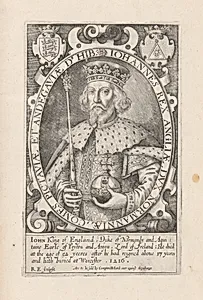
John, King of England
Medium
Classification
Department
Smithsonian Collection
Museum
Smithsonian American Art Museum
Credit
National Portrait Gallery, Smithsonian Institution
Accession Number
S/NPG.77.43.8
Rights
Public Domain
Tags
Art Historical Context
Behold the regal portrait of *John, King of England* (1618), an exquisite engraving by Renold Elack (c. 1570–c. 1625), a Dutch-born artist who became one of England's pioneering native engravers. Created over four centuries after King John's reign (1199–1216), this print captures the monarch in opulent attire—a flowing cape, jeweled crown, scepter, and sovereign's orb—flanked by his coat of arms. These symbols of power evoke the divine right of kings, a potent theme in early 17th-century England under the Stuart monarchy. Elstrack's work is part of the influential *Basiliologos* series, a lavish collection of portraits of English rulers from William the Conqueror onward, published to celebrate royal lineage amid James I's reign. King John, infamous for his baronial conflicts and the signing of the Magna Carta in 1215, is here idealized as a sovereign archetype, reflecting how history was reframed to bolster national identity. As a line engraving—a meticulous intaglio technique where intricate lines are incised into a metal plate—this print exemplifies the era's artistic innovation. Prints like this democratized royal imagery, allowing widespread dissemination beyond elite circles, and remain treasures in the Smithsonian American Art Museum's National Portrait Gallery collection. A window into Tudor-Stuart visual culture!