
Medium
Classification
Department
Smithsonian Collection
Museum
Smithsonian American Art Museum
Credit
National Portrait Gallery, Smithsonian Institution; gift of Mr. and Mrs. Paul Mellon
Accession Number
S/NPG.74.39.5.9
Rights
Public Domain
Tags
Art Historical Context
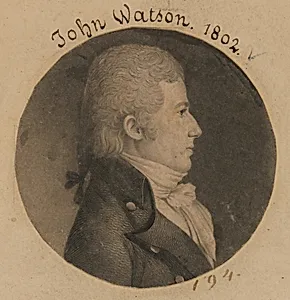
Step into the early 19th-century world of American portraiture with *John Watson* (1802), a delicate print by Charles Balthazar Févret de Saint-Mémin, a Frenchigré artist (1770–1852) who brought innovative techniques to the young United States. Working in Philadelphia and New York after fleeing the French Revolution, Saint-Mé specialized in precise profile portraits, often using a physiognotrace—a mechanicalograph device—to trace sitters' silhouettes with remarkable accuracy. He then engraved these onto copper plates, producing affordable, gem-like prints that captured the likenesses of prominent figures during the Federal era. This intimate portrait of John Watson exemplifies Saint-Mémin's signature style: a stark, cameo-like profile against a simple background, emphasizing physiognomy and social status. As a print medium, it democratized portraiture, allowing middle-class Americans to own sophisticated likenesses that were both artistic and collectible. Housed in the Smithsonian American Art Museum's National Portrait Gallery collection—thanks to the generosity of Mr. and Mrs. Paul Mellon—this work reflects the era's fascination with identity and self-presentation in a burgeoning republic. Today, it offers a window into 1802 America, blending European precision with New World optimism, reminding us how a single profile can encapsulate a person's place in history.