
John Wood Dodge
ca. 1836–37
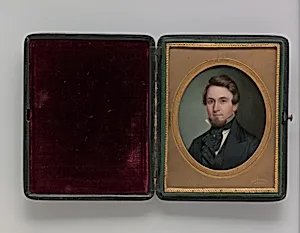
Medium
Watercolor on ivory
Dimensions
3 x 2 1/2 in. (7.6 x 6.3 cm)
Classification
Painting, miniature
Culture
American
Department
The American Wing
Museum
Metropolitan Museum of Art, New York, NY
Credit
Gift of Gloria Manney, 2006
Accession Number
2006.235.44
Rights
Public Domain
Tags
Art Historical Context
Step into the intimate world of 19th-century portrait miniatures *John Wood Dodge*, a delicate watercolor on ivory by Edward. Dodge, created around 1836–37. Measuring just 3 x 2½ inches, this tiny gem captures the likeness of its namesake subject—a poised American gentleman—with remarkable precision and lifelike detail. Housed in The American Wing of the Metropolitan Museum Art, it exemplifies the refined craftsmanship of early American portraiture. Watercolor on ivory was the gold standard for miniatures during this era, prized for its luminous translucency that allowed light to pass through the thin paint layers, creating a glowing, three-dimensional effect on the smooth ivory surface. These pocket-sized portraits served as cherished personal mementos, often worn as lockets or brooches by loved ones separated by travel or circumstance—especially poignant in an age before photography. Edward S. Dodge, a skilled Boston-based miniaturist, mastered this demanding technique, blending meticulous brushwork with subtle shading to convey personality in a format no larger than a modern smartphone screen. This artwork highlights the cultural role of miniatures in antebellum America, where they bridged the gap between formal oil portraits and everyday sentimentality. A gift to the Met in 2006, it invites us to appreciate how such small-scale artistry preserved individual stories amid a rapidly changing nation.
About the Artist
Edward S. Dodge · 1816–1857
1816–1857