
Joined armchair
Unknown Artist
1690–1720
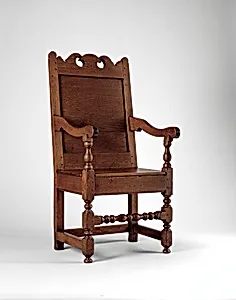
Medium
Black walnut
Dimensions
45 1/2 x 22 x 23 1/4 in. (115.6 x 55.9 x 59.1 cm)
Classification
Joined armchair
Culture
American
Department
The American Wing
Museum
Metropolitan Museum of Art, New York, NY
Credit
Rogers Fund, 1948
Accession Number
48.61
Rights
Public Domain
Art Historical Context
Step into the elegant simplicity of colonial American life with *Joined Armchair*, crafted between 1690 and 1720 by an unknown artisan. Made from rich black walnut—a durable, dark hardwood harvested from America's eastern forests—this armchair measures 45½ x 22 x 23¼ inches, offering a sturdy seat for the period's elite households. Its "joined" construction highlights masterful woodworking techniques, likely employing mortise-and-tenon joints to assemble the frame, a hallmark of 17th- and early 18th-century furniture making that prioritized strength and longevity over ornate decoration. Housed in The Metropolitan Museum of Art's American Wing and acquired through the Rogers Fund in 1948, this piece exemplifies the burgeoning craftsmanship of early American culture. Black walnut's fine grain and deep color made it a favored choice for high-status furnishings in New England or the Mid-Atlantic colonies, where English traditions blended with local resources. Unlike later Baroque extravagance, its restrained form reflects Puritan influences and practical colonial living, serving as both a functional throne for family patriarchs and a symbol of prosperity. Today, this armchair invites us to ponder the skilled hands behind anonymous colonial workshops, preserving a tangible link to America's formative years.