
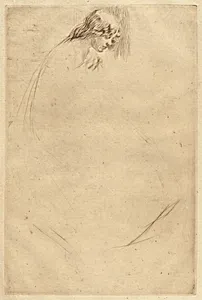
Jo's Bent Head
Medium
drypoint on laid paper
Dimensions
plate: 22.86 x 15.24 cm (9 x 6 in.) sheet: 29.21 x 19.37 cm (11 1/2 x 7 5/8 in.)
Classification
Department
CG-W
Museum
National Gallery of Art, Washington, D.C.
Credit
Rosenwald Collection
Accession Number
1943.3.8451
Rights
Public Domain
Art Historical Context
"Jo's Bent Head" (1861) is a delicate drypoint print by James McNeill Whistler, the innovative American-born artist renowned for his advocacy of "art for art's sake" and subtle tonal harmonies. Capturing the bent head of his muse, Joanna Hiffernan—affectionately known as "Jo"—this intimate portrait exemplifies Whistler's early mastery of printmaking during his Thames-side experiments in London. Created amid the bustling Victorian era, it reflects his fascination with everyday subjects elevated through aesthetic refinement, distancing from narrative storytelling. Whistler's use of drypoint on laid paper is particularly noteworthy. In this intaglio technique, he scratched directly into a copper plate with a sharp tool, raising a soft burr of metal that produces velvety, expressive lines upon printing. Unlike etching's crisp precision, drypoint yields a rich, atmospheric texture—evident in the gentle modeling of Jo's hair and neck—which fades with each impression, making early pulls highly prized. The modest plate size (9 x 6 inches) invites close viewing, revealing the paper's subtle chain lines characteristic of 19th-century laid stock. Housed in the National Gallery of Art's Rosenwald Collection, this print highlights Whistler's pivotal role in revitalizing printmaking as fine art, influencing modernists like Picasso. Visitors will appreciate its quiet elegance, a testament to Whistler's belief that harmony and beauty transcend mere representation.
About the Artist
James McNeill Whistler · 1834–1903
James Abbott McNeill Whistler (1834-1903) was an American-born painter and printmaker who became a leading figure in the Aesthetic Movement and pioneer of Tonalism and Japonisme. He revolutionized art by championing "art for art's sake" and treating paintings as visual equivalents of musical compositions, titling works as "arrangements," "harmonies," and "nocturnes" to emphasize formal qualities o...