
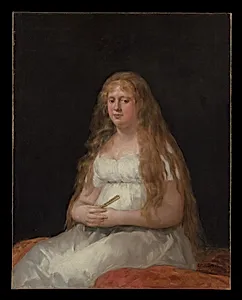
Josefa de Castilla Portugal y van Asbrock de Garcini (1775–about 1850)
Medium
Oil on canvas
Dimensions
41 x 32 3/8 in. (104.1 x 82.2 cm)
Classification
Paintings
Department
European Paintings
Museum
Metropolitan Museum of Art, New York, NY
Credit
Bequest of Harry Payne Bingham, 1955
Accession Number
55.145.2
Rights
Public Domain
Tags
Art Historical Context
In 1804, Francisco deoya y Lucientes, Spain's masterful painter of the late Enlightenment and early Romantic eras, created this striking oil-on-canvas portrait of Josefa Castilla Portugal y van Asbrock de Garcini (1775–c. 1850). At 41 x 32⅜ inches, the work captures the poised elegance of this noblewoman, whose multifaceted surname hints at aristocratic ties across Spanish, Portuguese, and possibly Dutch lineages. Goya, then at the height of his career as painter to the Spanish court, excelled in such intimate portraits, blending unflinching realism with subtle psychological depth. Painted amid the turbulent lead-up to the Napoleonic invasion of Spain, the portrait reflects Goya's signature style: loose, expressive brushwork in rich oils that conveys texture—from the sheen of silk to the warmth of flesh—while piercing the veil of formality. Unlike the stiff Rococo portraits of prior generations, Goya's gaze reveals character, making Josefa not just a symbol of status but a vivid individual. This technique foreshadowed his later, darker works like the *Disasters of War*. Today, housed in the Metropolitan Museum of Art thanks to the 1955 bequest of Harry Payne Bingham, the painting exemplifies Goya's enduring influence on modern portraiture, inviting viewers to ponder the personal stories behind historical grandeur.
About the Artist
Goya (Francisco de Goya y Lucientes) · 1746–1828
Francisco José de Goya y Lucientes (1746-1828) was a Spanish painter and printmaker considered the last of the Old Masters and the first of the moderns. Rising from modest provincial origins to become First Court Painter to Charles IV, Goya's career spanned the Enlightenment's optimism and the brutal Napoleonic invasion that shattered it. A mysterious illness in 1793 left him permanently deaf and ...