
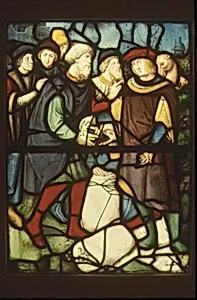
Joseph's Brethren Discover Money in Their Grain Sacks
Unknown Artist
ca. 1530
Medium
Colored, stains, and enameled glass
Dimensions
Overall: 36 × 26 1/4 in. (91.4 × 66.7 cm)
Classification
Glass-Stained
Culture
French, probably Rouen
Department
European Sculpture and Decorative Arts
Museum
Metropolitan Museum of Art, New York, NY
Credit
Gift of George D. Pratt, 1927
Accession Number
27.108
Rights
Public Domain
Tags
Art Historical Context
This vibrant stained glass panel, titled *Joseph's Brethren Discover Money in Their Grain Sacks*, dates to around 1530 and hails from France, likely the bustling glassmaking center of Rouen. It captures a pivotal moment from the Book of Genesis (42:35), where Joseph's brothers, returning from Egypt with grain, discover the silver payment mysteriously returned in their sacks—a divine twist revealing Joseph's secret benevolence and testing their integrity. Such biblical narratives were staples in 16th-century church windows, illuminating sacred stories for illiterate congregations through glowing colors and dramatic scenes. Crafted in colored glass, with silver stains (fired yellow pigments) and enamel details, the panel exemplifies Renaissance stained glass techniques. Pot-metal glass provided rich hues like deep blues and reds, while enameling added fine lines for faces, garments, and expressions, creating a sense of lively discovery amid the men's astonishment. Measuring 36 × 26¼ inches, it likely formed part of a larger Joseph cycle, blending medieval traditions with emerging naturalism. A gift to the Metropolitan Museum of Art from George D. Pratt in 1927, this rare survivor highlights Rouen's legacy in decorative arts. Gaze closely at the brothers' varied poses and sack details—they invite us to ponder themes of providence and family reconciliation still resonant today.